Top Links

Books                  About
Showing posts with label "Always a Cold Deck". Show all posts

Always a Cold Deck

This is the first Harry Reese Mystery, and the first fiction I’d written since school. Needless to say, the manuscript required a great deal of work before it was presentable. If my wife hadn’t been an editor (and a very patient one), the production costs would have been prohibitive. That’s true of the rest of the books, but particularly true of this one.
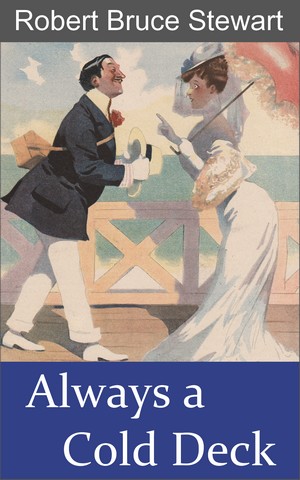
Always a Cold Deck
I had three objectives in mind for the book (and each of the subsequent ones as well): it should be a satisfying mystery; it should be faithful to the period; and it should be humorous. I soon found this to be more difficult than I had expected.

I began hoping to include as much historical detail as possible, and sometimes I let interesting bits of research entice me to stray from the plot. The first part of the book centers on a fire at the Eastern Elevator Company in late July 1900. This was a real company and the fire did take place as depicted. That was the story that first caught my eye. Some of the shadiness depicted is also based on truth—it had defaulted on the mortgage, and there had been a stock scandal involving manipulation of its share price. Though much research went into the depiction of Buffalo, its buildings, entertainment of the time, transportation, etc., I gradually learned to keep the overt references—like the visit to Dr. Linn’s Museum—to a minimum. That meant a lot of the research was left unused for the good of the mystery. Once the idea of smuggling comes in, the story is almost purely fiction.

Harry is meant to be a sort of everyman. He has no outstanding talents or eccentricities, but he is reasonably intelligent and seems never to lose his sense of humor. The introduction of a love interest was always in the back of my mind, but once Emmie entered the book she took on a life of her own. With hindsight, it’s obvious she was the essential element, and later I went back and trimmed the opening chapters so her appearance came all the sooner.

One minor part of the book, but which I look back on fondly, occurs when Harry and Emmie visit a concert saloon:

Just about then a piano player got going. He sang along with himself. Not well, perhaps, but one could understand the lyrics of each song and that struck me as rather novel for a concert saloon. These were the usual tunes one would hear in any parlor, but the artiste had taken certain liberties with the lyrics. In his version of the old standard She Loved Not Wisely, But Too Well, “she” also did it quite often.

That piano players would take liberties with lyrics was my conjecture—an educated guess based on the fact that those of published music were absurdly tame, and yet there were an infinite number of rowdy places of entertainment. Later, I found confirmation of this in Mark Sullivan’s  Our Times.

In some ways, this was the most enjoyable book to write. My expectations were modest and my enthusiasm unchecked by subsequent disappointments. And though I didn’t feel completely satisfied with the finished product, I did take a great deal of pride in having completed it.


There’s more on Always a Cold Deck, including its availability, at the Harry Reese Mysteries site.

Buffalo at the Turn of the 20th Century

Labor Day Parade in Buffalo, ca. 1900.
Until 1817, Buffalo was a small village like many others along the Great Lakes. But that was the year work began on the Erie Canal, which would link Lake Erie with the Hudson River. Completed in 1825, the Canal was a very costly, and risky, public works project. But it was wildly successful and would assure the prosperity of New York State--and, even more particularly, that of New York City, at the base of the Hudson, and Buffalo, at the western terminus of the Canal.

Elevators, canal boats, lake steamers & harbor ferry.
At a time before railroads, or even serviceable highways, goods could be brought to Buffalo by ship and transferred to canal boats. Grain was the main cargo of the ships arriving from the Midwest, and Buffalo soon became a major distribution point for wheat and other grains. In 1842, the first grain elevator was built in Buffalo. The elevator used steam-powered conveyers to unload the grain from ships and into bins within the large wooden tower. Throughout the 19th century, the towers grew in number and size, even as railroads supplanted the Canal.


By 1900 Buffalo held a key position as a transportation hub. Grain, iron ore and lumber came in from the west, while coal and other goods arrived from the east. As a consequence, both flour and steel mills developed into major industries. And since all the major railroads of the northeast serviced Buffalo, they too became major employers. The population of the city was growing rapidly and stood at 350,000. Buffalo was then the 8th-largest city in the U.S. (in 2011, it was #72).

As with a lot of American cities, Buffalo was in the middle of a great building boom. In 1896, Ellicott Square (above) was completed. Taking up an entire city block, it was at the time the world's largest office building. What's more amazing, it still is intact.


Another amazing thing about Buffalo is the devotion of its fans to its history. One of the best local history sites on the Web is Chuck LaChiusa's Buffalo Architecture and History, which has individual pages for individual buildings as well as architects. For instance, there is a page for  Frederick Law Olmsted, who designed a number of Buffalo's parks, including Delaware Park, seen above on a busy day.

But no discussion of Buffalo in 1900 can be complete without mention of the grain scoopers and the harbor ferries, both explored at local history sites well worth visiting.

Useful Maps, ca. 1900

I'm one of those people who love maps. And I've come across all sorts of interesting maps in my research.

The most interesting of all is a perspective map of Buffalo from 1902, which the Library of Congress has put up in a zoomable version.

What you see at right is a corner of the city along the waterfront. That's maybe 2% of the map. The buildings are rendered with such detail that many are identifiable from photographs. There are a lot of perspective maps from the period, many in the Library of Congress's Cities & Towns collection. But I've never seen another with anything like this level of detail. It's like a Google Street View from 110 years ago.


If you want to see how people got about, you need a map like this Rand McNally 1897 map of Brooklyn. The red lines are the street car routes, and the dashed lines in the river are the ferry routes.

This is from the David Rumsey Map Collection, perhaps the largest available online. But there are dozens of smaller collections, many at state and municipal library sites.


Topographical maps from the U.S. Geological Survey offer fairly precise information about an area. For instance, the portion of the map at right is from 1898. I found it at the University of New Hampshire. It shows an area of Brooklyn between Prospect Park and Sheepshead Bay. In less developed areas like this, the USGS maps show individual buildings.

Interestingly, most maps of the period show the area's streets already laid out. But from this we can see it was still open ground. And from what I've read in newspapers of the time, some was still wooded.


Real estate atlases offer another interesting point of view. A number of these are online, including Baist's Real Estate Atlas of Surveys of Washington, D.C.  at the Library of Congress.

The close-up at left is of an area between G & H Streets, NE. The pink buildings are masonry, the yellow wood-frame. H Street is at the top of the image. Cabbage Alley, which I've labeled, was one of many inhabited alleys in Washington. The poor, mostly African-Americans, resided in the alleys. The dwellings were primitive at best and the bane of public health officials. And though the politicians and the press managed to ignore them for years, the map makers recorded them in detail.

Dr. Linn's Museum of Anatomy

Museums of curiosities were very popular in the 19th century. These museums encompassed all sorts of exhibits, and sometimes live performances, but most included anatomical specimens and figures in wax, often depicting grotesque deformities and maladies. P.T. Barnum's museum in New York  eventually evolved into his circus.

Dr. Linn's Museum of Anatomy was located in Buffalo during the late 19th and early 20th centuries. It was right on Main Street, just down the block from the city's finest hotel. I'm fairly sure the sign in the photo at right is for Dr. Linn's. It's actually a different part of the photo that I use as the background.

Museums like Dr. Linn's included a variety of exhibits of animals and humans. But they were usually intended to provide clients for the proprietor's medical practice, which explains why there was an emphasis on diseases of men, particularly venereal diseases. Many of the exhibits were used to illustrate the consequences of leaving such cases untreated. After putting the fear of God into their patrons, placards or ushers would make them aware that an experienced doctor was on hand for immediate treatment. Perhaps the anonymity was part of the attraction for patients not wanting to consult the family physician.

The image at left is the cover of Dr. Linn's catalog from 1896 that was sold in an auction a while back. The seller noted that there was "an emphasis on sex organs and diseases, although there are insects, a pterodactyl, shellfish, snakes, etc., and engravings of George Washington." Another description of one of these museums is found in an 1873 medical journal and quoted in Michael Sappol's excellent article "Morbid curiosity: The Decline and Fall of the Popular Anatomical Museum":

It was a collection of anatomical models and dissections, with representations of skin and venereal diseases, most improper for public exhibition, and calculated to excite the morbid curiosity of the young together with its peculiar forms of hypochondria. Vile pamphlets were on hand to induce those having or fearing disease to consult the proprietor. The harm which this single establishment must have done cannot be calculated.

As Sappol explains, the museums provided "plenty of models and specimens of vaginas, penises, breasts, and partly dissected (and therefore unclothed) females." At a time when social norms forbade nudity, science was often used as a means to titillate. Here is an interesting wax model of this kind featured at the Morbid Anatomy blog:


Though mainly intended for a male clientele, Dr. Linn's also provided separate hours for ladies on Friday afternoons, when female ushers took the places of the men. But how many women were willing to enter a place like this in the middle of the shopping district?